Reverie

02242017 1.jpg

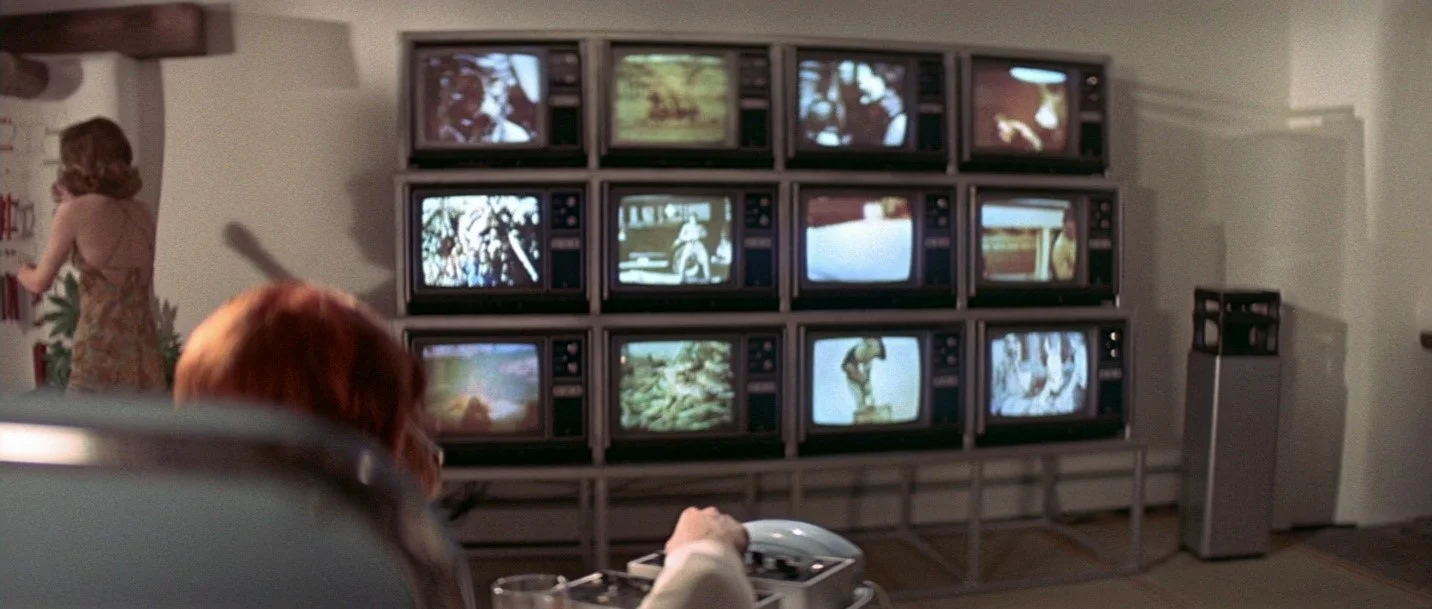
Today’s world is a constant input of inputs—newsfeeds, weather updates, Facebook, Instagram, Twitter, LinkedIn—everywhere the world feeds us input (I don’t say “information” because the input is fact and fancy, information and opinion, important, diversionary, entertaining). I do not decry the input because I participate in it fully and constantly…why watch only a game on television when I can watch the game and see scores and injury reports on a constant ticker at the bottom of the screen? Or when I can use the remote to toggle between two games? Sometimes I feel like Bowie’s character, Thomas Newton, in The Man Who Fell to Earth (1976), watching a dozen TVs at once.

But this constant input comes at a cost of something that I value, something I recommend: “reverie.” Do we take time—actually take time, seize it, steal it for ourselves—to be alone in personal consideration of what and how we think? Reverie: to be lost in one’s thoughts, to daydream. Freud called daydreaming “infantile;” schoolkids are reprimanded for it; Walter Mitty is considered a fool for too much of it…but therein lies the richness of each of us. Yes, the world forces input on us constantly, but what’s on the inside already? What are the riches of our thoughts left alone to wander and grow by themselves…and how do we discover them?

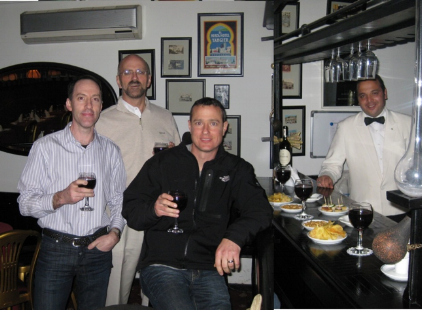
Moeder’s in Amsterdam is covered floor-to-ceiling with customer-contributed pictures of mom.

Moeder’s in Amsterdam is covered floor-to-ceiling with customer-contributed pictures of mom.

My reverie comes most readily when I’m driving long distances…to the Jersey shore, for instance—a drive of some hour or hour-and-a-half. For years, I’ve enjoyed that drive late at night to avoid the traffic, coursing the dark, flat stretches of road that cut through the Pine Barrens until I fall into a reverie.  A reverie as if I were spying or eavesdropping on my own mind, all the events and memories, people and places tumbled together and newly perceived. I’ve written before about the enjoyable power of memory, but in reverie, I can blend an historic past with an imagined future and find new ideas, rich new thoughts, surprises: my morning in Amsterdam when I visited the Anne Frank house and later visited a restaurant that accepted for display a picture of my mom…the memories morph into ideas about my sisters and mother and visions of a future Amsterdam trip with my family; a race climbing the stairs to the top of Sacré-Cœur in Montmartre with my friend and his son—no real race at all because I was dragging behind, panting, and thinking, “At least I’ll die in church!”—the memory expands into concepts of vision (the city of Paris spread out below) and religion and death and redemption…in reverie, my mind gets whirled up with blended ideas and observations, truths mixed with hopes mixed with plans.

The church of Sacré-Cœur towering above Paris.

The church of Sacré-Cœur towering above Paris.

But in today’s world, I’m forced to steal the time and steel myself to get lost like that—to shut off the radio and television, to turn away from the computer and smartphone, to let my mind disconnect from the input—to get lost and find what’s inside already. 

Somewhere

On a brief walk on a beautiful afternoon last week, I noticed three jet vapor trails in the sky, each headed in a different direction. I found myself wondering where everyone is going and why aren’t I going, too. I couldn’t actually see the jets except as quick glimmers of reflected sunlight, but the vapor trails were plain-to-see, very high, very long, and going somewhere. It was another theme to which I became attuned...another theme that echoed through my weeks.

In a day or two, my playlist happened onto Brian Eno’s “Spider and I,” a quasi-ambient tune from his 1977 album, Before and After Science. I remember even then imagining the world beyond that the lyrics evoked, hearing a hymn to a distant vision. The spider hopes to catch a fly…an emissary from somewhere, and the singer dreams of a ship going to that place, going somewhere:

We sleep in the mornings,
We dream of a ship that sails away, 
A thousand miles away.
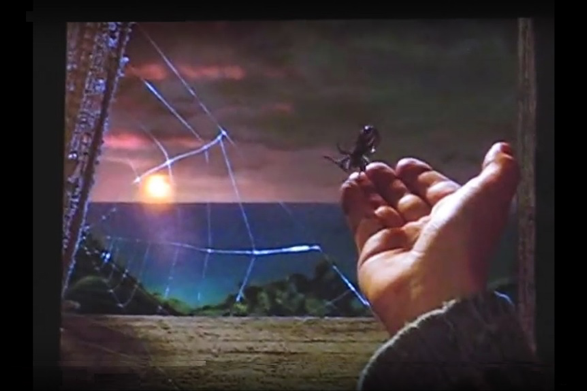
© 1996 Disney Enterprises, Inc.

© 1996 Disney Enterprises, Inc.

In my mind, that song is linked with Tim Burton’s film version of James and the Giant Peach (1996), where one of James’s first visions of a world beyond—he dreams of going far away to New York—comes as he befriends a spider on her web in the window, to whom he sings his introduction. It’s a fantastic scene of introduction to and definition of the character, James: a frustrated, gentle heart; a youthful visionary; a dreamer…it expresses the same theme of longing to go somewhere, with a quick glimpse to the horizon and James’s “dream balloon” sent adrift:

There's a city that I dreamed of
Very far from here
Very very far away from here
Very far away

021917 3.png

Hearing Eno’s song, my mind drifted to a time when I visited Taormina with my family…Taormina itself a world beyond for me, a somewhere.  On our first night there, we walked the main shopping street to a piazza and balcony 500 meters above the water. A masted sailing ship lay in harbor; we had noticed it earlier (everyone noticed it…it was beautiful!) as we drove in on the winding, cliff-hugging road to the hotel. From the piazza, we saw the lights outlining the masts in the blackness of the nighttime water. Later when we returned to the hotel, I sat on the balcony to relax and rest from our long travel-day; just then, the ship silently set sail and slowly, gracefully glided across the cove in front of the hotel and disappeared past the rocky point to the north…it could not have been more provocative. Who was on it and where were they going and why were they going? So silently, so darkly…had it had no lights, it simply would have vanished in the night! My trip was a bit of an escape for me, but such a ship on such a night in such a place…going somewhere.

Old-time New Brunswick, NJ train station.

Old-time New Brunswick, NJ train station.

Long ago when I was in college, the New Brunswick, NJ train station had a platform that was down at track level; today the platform is raised so that one directly enters the train at compartment level. Back then, one entered the train by climbing stairs up from the gravel-tracks-ties level. Whenever I was feeling a sense of frustration or adolescent/collegiate angst, I would go to the station and wait and watch the trains roar by. The signal lights to the south would change to vertical—train coming—and I would watch to the north as the express would come within minutes around the curve. Despite its size and power, the trains came in silence until they were nearly at the station. I could stand just feet from the track (foolishly standing on or beyond the yellow STAND BACK OF YELLOW LINE marker) and get punched by the force of air that the train drove out ahead of itself, feel the rumble of incredible mass—tons of steel at high speed. The Metroliners would rush through the station at 90 miles per hour…giving an enormous exhilaration that always dispelled the angst. While waiting for the next train, the next exhilaration, I would look down the tracks with a sense of reverie, tracks that ran straight for miles and narrowed and narrowed until they seemed to meet at the horizon. The tracks disappeared beyond the curve of the world and I wondered, where did they go and how far could they take me? 

Without knowing any connection, last weekend I began reading Ayn Rand’s Atlas Shrugged…I am completely enjoying it. The theme of “going somewhere” announced itself again. I came across a passage about one of the main characters’ dreaming at the images that pass by outside her train window:

“As men on a dark prairie liked to see the lighted windows of a train going past, her achievement, the sight of power and purpose that gave them reassurance in the midst of empty miles and night—so she wanted to feel it for a moment, a brief greeting, a single glimpse, just to wave her arm and say: Someone is going somewhere…”

This theme for me is as old as me. As a little boy in rural Clementon, NJ, I would hike with friends and against my mother’s wishes along the train tracks for as far and for as long as we could dare. We would leave “civilization”  behind and follow the tracks through the pines and—while we were only a town or two away—we never felt that we had gotten quite anywhere, only that we were headed somewhere.  
 

Monstrous

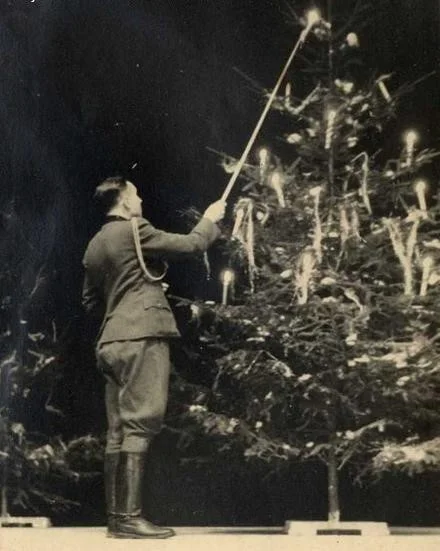
© United States Holocaust Memorial Museum 

© United States Holocaust Memorial Museum
 

Can’t tell if it’s a blessing or a curse…but once I recognize a theme, I seem to find it over and over again. My mind seems easily to adopt a pre-sensitivity to certain ideas, and then I find them echoed in reality and stories and movies.

Two weeks ago I watched a powerful documentary about photo albums of the people at the Auschwitz death camp, photos of both the captors and the victims. The story of the documentary went on about how the photo album of the German soldiers showed “plain people living regular lives.” Officers and soldiers and their families were gathered at picnics and relaxing and singing and even lighting their Christmas trees. Rebecca Erbelding, a Holocaust Museum archivist, characterized it this way, “Without the context of what they’re doing in Auschwitz, this is an album of fun.”

The second album, photographed on exactly the same days, examines the process by which the Jews were delivered by train, “selected,” dehumanized, and marched off to death…mercifully for us, the murders aren’t depicted in the albums. Seeing the albums, I found myself realizing completely how individually “human” each person was. What must have been the terror in the hearts and souls of the victims…husbands separated from their wives, parents (young and old) separated from their children?

Just as frightening was the question posed by the makers of the documentary: the album showed the soldiers to be humans…not monsters from whom we would expect only horrors…but humans who somehow were capable of monstrous things. “Why do people kill? Why were so many people able to do this in the heart of such a civilized nation?” asks the narrator. The narrator says that thinking of the soldiers as “monsters” makes the answer too easy: monsters kill. But realizing that human beings can do “monstrous” things is terrifying.

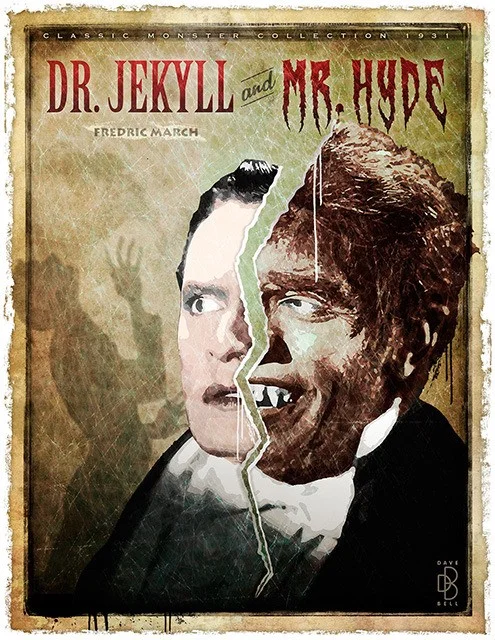
In the weeks since then, I’ve come across the same theme in very different contexts; but the question is clear: what evil lives within each human? And how do we overcome it? I watched Fredric March play Dr. Jekyll in the 1931 movie version of Robert Louis Stevenson’s classic, Dr. Jekyll and Mr. Hyde. Some of it was as corny as we expect a 1930s movie to be…but at its core, and central to Fredric March’s Oscar, is the question of a monstrous evil within. March does an excellent portrayal of both Dr. Jekyll—intelligent, respected, and polished; and the monstrous Mr. Hyde—unrestrained, lecherous, and dangerous. Stevenson examines the question in his novel in 1886 and we continue to be fascinated by the theme…movie versions retell the tale in 1912, 1920, 1931, 1941, 2008, and 2017. It occurred to me that this is a similar theme that brought us The Wolfman (1941) and maybe even Marvel Comics’ The Incredible Hulk. Beware the kindly Lawrence Talbot and Bruce Banner when the inner monsters are released!

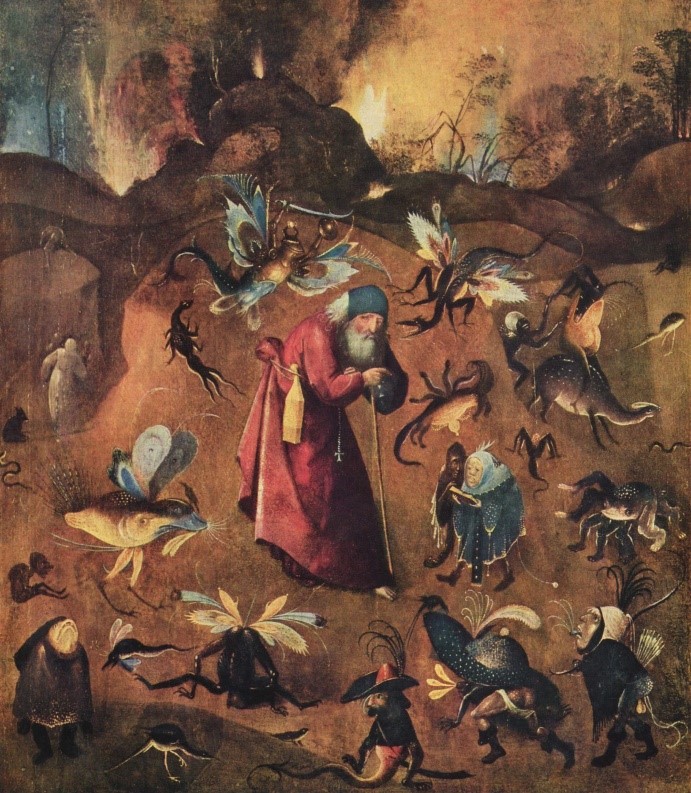
The Temptation of St. Anthony (Detail) c. 1502.

The Temptation of St. Anthony (Detail) c. 1502.

I’m reading a book about Hieronymus Bosch (c.14501516), an artist of “nightmarish details and fantastic painterly schemes,” and I’ve come across the same theme again, what evil lives within each human? And how do we overcome it? In this case, the examination of the theme is 500 years old! At the turn of the 15th Century, Bosch populated many of his paintings with grotesque representations of half-human/half-animals, disfigured humans, and humans doing bizarre and monstrous behaviors. He constantly portrays the evil—in 1500’s terms, the “sin”—of which we are capable. In his world and in his art, Bosch specifically shows the redemptive power of faith to overcome the evil. In his world and in his art, Bosch clearly shows the beauty of the angels and saints in contrast to the “beast in man” that haunts us all.

From 1500’s art through 1800’s books and 1900’s movies, the theme of “an evil within” is continual. More terrifying, though, is finding it demonstrated so readily in reality. From the massive genocide of the Nazis to the current genocide of ISIS and down to the smaller, more personal attacks in Quebec and Charleston…the question remains, “Why are people able to do monstrous evil in the heart of such a civilized world?”

Behavior

I don’t know if she coined the phrase, but my wife is the first person whom I heard speak it…and she has spoken it frequently over the years. Mostly to our children, as they were growing up, she used the phrase as a warning for them to expect and deliver the best of themselves all the time. Especially when life was challenging and one person or another made it more challenging—a bully, a cheater, a liar. Children being children, they usually wanted the world to be “fair,” and so they felt justified or sorely tempted to retaliate. But my wife coined (I think) a pearl: “Don’t let other people make you a bad person.” 

It seems a simple concept, simple enough that my children understood it from their youngest years. Just because someone else does something mean, dishonest, immoral does not give any of us license to do something else mean, dishonest, immoral. The more I heard the expression, the more I liked it; I realized that it presumed that my children were good to begin with…an important perception that we should all have and pursue about ourselves…though that is not always the lesson taken from the phrase.

In recent days, I have seen bad people with bad behaviors make others—many others—behave badly. The political world is aflame with name calling and other inflammatory rhetoric, prejudices, personal insults, and general vulgarity. 

Donald Trump ran a campaign full of insult, prejudice, and vulgarity…I am not speaking politically or judging him politically here; regardless of policy or platform issues, he constantly attacked people on personal grounds, on racial or nationalistic grounds, and often used language formerly excluded from presidential campaigns. Especially in his leadership role, his language and comportment are, in my opinion, bad behaviors.

Serge Kovaleski, investigative reporter at The New York Times.

Serge Kovaleski, investigative reporter at The New York Times.

The world seems to have chosen to meet him in the gutter. Clinton’s campaign against him included the constant re-airing of Trump’s mocking a disabled reporter, Serge Kovaleski. Every day, we got to see that particular bad behavior over and over and over again. Meryl Streep went on to say at the Golden Globes award evening that Trump’s behavior “broke her heart”…but she was also made to relive it multiple times a day on television. 

The Women’s March on Saturday appears to have given many the license for overwhelming self-righteous bad behavior…justified usually in the name of equality or liberty or freedom. People personally attacked Trump and his family in terms as bad—and at times worse—than Trump used. For me, any positive message was lost in the excess of vulgarity.

Facebook has become a feeding ground of mockery and meanness and vulgarity…from the right and the left…calling each other horrid names, attributing frightening motives and frightening debaucheries to each other, wishing unspeakable things. In the name of denouncing prejudice, people deal with each other prejudicially; in the name of denouncing insensitivity, people have been highly insensitive; in the name of political freedom, people have insisted only on their viewpoint.

On a very personal level, recently I’ve been lumped into a group being prejudicially blamed for what’s wrong in the world. “Old white dudes,” writes a friend, are ruining everything. I’m an old white dude and I don’t think that I’m at all responsible for any of the negativity—political or behavioral—going on in the world today. I think that friend let others’ bad behavior affect him, because I know he is not a prejudicial person. In fact, I presume he’s a good guy to begin with.

In fact, I’m going to take my wife’s warning to heart: I won’t let others make me a bad person. I want to see change, I welcome protest, I accept resistance…especially against anyone’s bad behavior.


Facts

There was a time when news reporters prided themselves on reporting only confirmed facts...never just opinions. Their focus on facts may have been an outgrowth of war-reporting during World War II, when an erroneous report could create a false sense of loss or a false sense of security for millions of readers and listeners back home. That “focus on facts” persisted through the early years of television news and became a litmus test for network news.

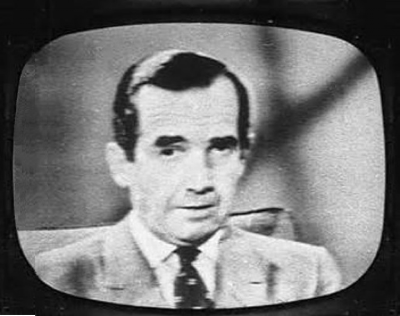
In the 1950s, Edward R. Murrow, a kind of “granddaddy of news reporting,” grew his reputation by focusing on facts. His legendary rebuke of Senator Eugene McCarthy was based on facts, often citing McCarthy’s own words; when McCarthy defended himself by accusing Murrow of being “a Communist sympathizer,” Murrow’s response was simple: McCarthy “made no reference to any statements of fact that we made.” Facts carried the day, McCarthy was exposed, and the value of network news—and sticking to the facts—was clear. 

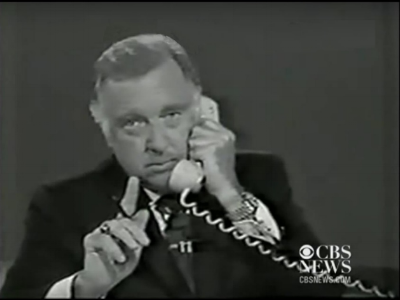
In the 1960s, Walter Cronkite ushered in CBS’s Evening News and became “the most trusted man in America.” When Cronkite hosted a CBS News Special, Report from Vietnam: Who, What, When, Where, Why?, he began to question the “facts” that he had been reporting about the Vietnam conflict.  He publicly offered his opinion, but made it clear that it was his opinion: “…an analysis that must be speculative, personal, subjective.” He went on to comment, “…it is increasingly clear to this reporter that the only rational way out [of the Vietnam conflict] then will be to negotiate, not as victors, but as an honorable people who lived up to their pledge to defend democracy, and did the best they could.” He maintained the difference between the facts and his opinions. Cronkite’s opinion carried weight—President Johnson recognized how he had “lost America”—but Cronkite's reputation had been built on his respect for facts.

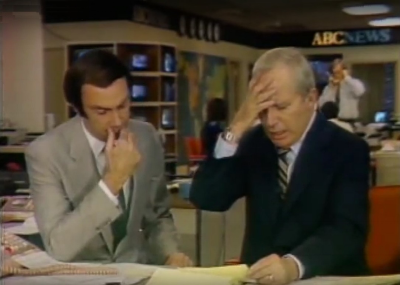
In 1981, ABC News’s Frank Reynolds struggled to focus on facts as he reported the assassination attempt on President Ronald Reagan. Even as he narrates the video of the attempt, he measures his words to be factual. On live TV, he insists on “confirmation” of information coming to him over the phone. “Wait a minute…I’m on the air and I’m trying to get some more information. You say the president has gone to the hospital. But can you confirm that he has not been taken to a hospital?” Later, Reynolds is clearly shaken that he has misreported information; he says, “He was wounded…” [grabbing his head] “...God. …All this that we’ve been telling you is incorrect. We now must redraw this entire tragedy in different terms.” To Frank Reynolds, his responsibility was to the facts…and reporting the facts to the American public.

Even on September 11, 2001 as tragic events unfolded, Peter Jennings of ABC News was careful to segregate his opinion (at 10:24 in the video) from his factual reporting. “We do not very often make recommendations for people's behavior from this chair but ...I checked in with my children who are deeply stressed, as I think young people are across the United States. So if you're a parent, you've got a kid in some other part of the country, call them up. Exchange observations.” He was in his twelfth hour of reporting, but he maintained the difference of being in “this chair” as a news reporter and maintained the difference between fact and opinion.

In contrast, today's pop-star media feast on delivering opinions and generating controversy. “Facts” are couched within agendas—right- and left-wing—and lost within sarcasm, self-righteousness, and opinion. Rachel Maddow is no more a news reporter than is Rush Limbaugh; Chris Matthews is no different from Sean Hannity…they are commentators and opinionators who unapologetically bring an agenda to anything they present.

I struggle every day to find facts…to ignore the overflow of founded and unfounded opinion on television, the internet, and overwhelmingly on Facebook; to ignore the paranoia and exaggeration and aggression that everyone seems to feel entitled to express. Ironically, “facts" seem to be casualties of our information age.

Snowflakes

Snowflakes falling always capture my imagination. Their whiteness or their fluttering motion or their unhurried pace toward the ground or their silence…I don’t know what it is, but I know that they capture my imagination. If I watch them from the window as they drift down to meld into the snow on the ground, or if I drive through them and see them explode on my windshield, or if I walk among them and feel them instantly melt against my cheek…snowflakes falling hypnotize me.

It is true. My memories are stronger when they are dressed in snowflakes. I remember days even in my youngest years when they include snowflakes falling…more than 50 years ago when I was younger than 10 and walking through the forest behind my boyhood home, I noticed how the pine trees formed caverns beneath their snow-covered branches; on all fours I shimmied into a cavern and, seated on pine needles, “watched the woods fill up with snow,” as Robert Frost says. Snow fell fast, “flakes” of snow that seemed more like cotton balls, and the snow was already deep outside the cavern. Night had fallen, but the brightness of the snow made everything visible; I remember watching my brother and sister pass by my hideout, their feet crunching the snow, their voices dampened by the snow, and a soft hiss of constant snowflakes falling on the piling snow.

I remember waking one morning 40 years ago while on a solo backpack trip to hear the tap of snowflakes on the tent…opening the flaps, I found the ground white with snow and the flakes falling fast. My shivering hampered my campfire-building efforts, because I had jumped out of the tent to start the fire quickly before the snowfall covered everything. Soon, I was warmed by flames, oatmeal, and a cup of thin coffee while being constantly pelted by snowflakes, snowflakes that disappeared above the flames or were diverted by the flow of the hot air rising.

I remember 20-some years ago a night when I pulled my son on his sled through snow-covered streets; we were bundled against the cold and falling snowflakes, but we were cold notwithstanding. The snowfall was heavy enough to halt all traffic through the neighborhood, except for a front-end loader plowing the parking lot at the train station. We watched with equal fascination as the plow plowed mountains of snow, only to watch the ground go white again in minutes. The plowman waved to us from his cab and my son said, “I’m having great fun, dad.”

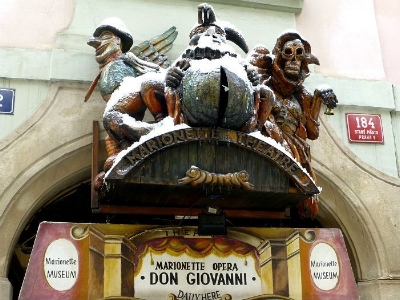
I remember 10 years ago on my hasty visit to Prague, how I toured the city in a constant halo of flurries. They never came fast enough to cover the ground with anything more than snow-swirls along curbs and around my ankles, or tiny drifts in picturesque nooks. I was surprised to see the reflection of my bundled self in the window of the marionette museum…in my hat and scarf and coat, I looked like the cold marionettes in their elaborate costumes behind the glass, except that I was dusted in snow. I realized how being among snowflakes gives me that unreal sense of being alone in a dream: sounds are deadened, shapes are softened, colors are blanked, place and time and distance are enclosed around me.

Then in 2011, Kate Bush released her album, 50 Words for Snow and I was mesmerized by her song, “Snowflake.” In the melodic, repetitive music, she expresses the dreamlike sense of a drifting snowflake riding its way through the sky earthward; the choirboy vocals of her son, Albert, give a tone of altitude and lightness; and the lyrics question every element of snowflakes that hypnotize me: being lost in silence in graceful motion outside time…only to find oneself “here.”

I found this exact sense, again, this weekend; while it snowed outside my window, I read The Snow Child, a finalist for the Pulitzer Prize in 2013, by Eowyn Ivey. It is a kind of a modern fairy tale that takes place in Alaska, where snow, obviously, is central to the tale. I found the same dreamlike sense of snowflakes, the same immediacy of them:

The swirl overhead was dizzying, and she began to spin slowly in place. The snowflakes landed on her cheeks and eyelids, wet her skin. Then she stopped and watched the snow settle on the arms of her coat. For a moment she studied the pattern of a single starry flake before it melted into the wool. Here, and then gone.

I think that I have found this to be true: snowflakes falling capture our imaginations.

Resolution

Normal
0


false
false
false

EN-US
X-NONE
X-NONE


 <w:LatentStyles DefLockedState="false" DefUnhideWhenUsed="false"
DefSemiHidden="false" DefQFormat="false" DefPriority="99"
LatentStyleCount="…

Sunset Beach, Cape May, NJ.

Whether you use the Oxford English Dictionary or Merriam-Webster Dictionary or even the latest Dictionary.com…everywhere, the definition of the word “resolution” includes being “firm” or “determined” or “formal.” Last New Year’s Eve, I resolved an achievable idea…nothing grand, but I chose a real resolution about which I was and could remain determined…

I had talked about starting a blog for a long time, but this year was the year: “I want to assert my continued relevance...” My resolve was not immediately productive…I posted my first blog on May 16. Starting the blog, I had forced weekly discipline on myself, a discipline to craft a correct, meaningful, brief essay. I’ve not reached the readership I wished for, I’ve had pitifully few comments and “likes” along the way, but this is my twenty-seventh entry…I congratulate myself that I was firm and determined in my 2016 resolution.

Importantly, I’ve enjoyed a significant side benefit to my resolution: I’ve learned to pay close attention to even the small things and moments in my life. I’ve enjoyed, suffered, relished, grieved, struggled, savored, resisted, and wondered each of the 366 days of the year! I worry how many days and moments simply passed me by—like letters coursing through the Post Office—in past years. But in 2016, I paid uncommon attention to the days and moments, pursuing my “blog resolution.” Many moments became blog entries: summer storms and rainbows, visits to museums, meteor showers, the election, etc.

But much of that side benefit has simply been to know, every day, that I’m alive and presented constantly with moments worth noticing. Moments worth noticing from the simplest joys—enjoying summer’s South Jersey produce or reading Dante’s Divine Comedy; to the most profound events—a farewell party of friends and family when I left my former job or reading the beautiful eulogy written by my wife at her mom’s funeral. The year took me everywhere, and fortunately I noticed more of it than ever before.

We watched a special presentation of Fritz Lang’s Metropolis (1927) at the Kimmel Center, a screening accompanied by the Center’s Fred J. Cooper Memorial Organ…an accompaniment that vibrated the house; a friend and I saw Sophia Loren—still beautiful at 82—interviewed in her charming, broken English; I spent an evening on-the-town in NYC, dining at Gotham Bar & Grill and then startled by American Gothic; my family completed a “pilgrimage” to premium seats to hear Brian Wilson play Pet Sounds; I watched one evening after sunset as Venus and Jupiter met in the sky, even though in reality, they're about 450 million miles apart (They won't meet so closely again until 2065...I expect to be moldering by then, if not completely moldered); I helped a friend through cancer treatment and then, two months later, fished him out of the bay when he fell out of the kayak…all moments worth noticing.

Pay attention—I did—because those moments come and go so quickly. Late in summer, my daughter and I drove across the Cape May peninsula just to watch the Sun set into the Delaware Bay. When we arrived at Sunset Beach, we found a crowd of about 300 other sunset-watchers crowded on the beach; just ahead of sunset, officials lowered the flag and played the National Anthem over a loudspeaker…all 300 paused, many removed their hats, many even put their hands over their hearts. Then the Sun graced us with a dazzling sunset behind wisps of cloud. As darkness fell, we drove halfway back across the cape where we happened upon a quaint little restaurant housed in the back half of a general store. We enjoyed a bread plate to start and a vegetarian gnocchi plate with local ingredients and a local Cape May wine…all made greater by the serendipity of finding the restaurant right there, right then. We cruised around a very dark Cape May Point and climbed the steps over the dunes—large, elaborate dunes covered with sedge to protect the neighborhood—and enjoyed a moonlit view of the ocean meeting the Delaware Bay…all moments worth noticing.

I had made a resolution to blog; keeping the resolution led me to very much more. Happy past year, happy new year!

Birth

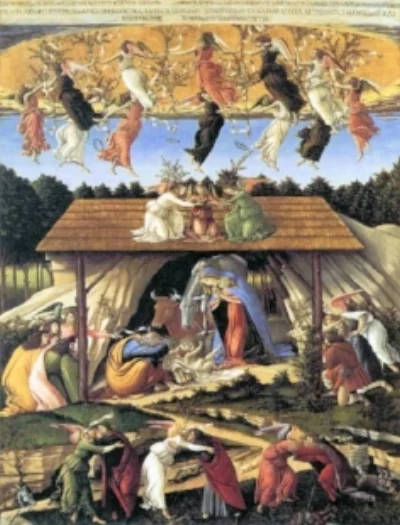
Mystic Nativity, (1500) by Sandro Botticelli, in the National Gallery, London, England.

Mystic Nativity, (1500) by Sandro Botticelli, in the National Gallery, London, England.

If you are expecting or if someone close to you is expecting at this time of year—especially if it’s late in the pregnancy and people can easily see and are often compelled to touch your belly—then you have a special window into the Christmas season. Too often we lose sight of what is central to the season; we are seduced or tempted or deceived into the “Pop” ideas of Christmas: gifts and romance and Santa Claus. But if you are connected to a pregnancy—a great expectation—then you’re easily reminded that Christmas is about fulfillment, promise, and hope. 

We were expecting at Christmastime many years ago…my wife was in her eighth month, so her belly was big and seemed to invite people’s not-always-welcome attention. “Is it a boy or a girl?”…we had chosen not to find out; “When are you due?” …in about a month, but our first-born came late, so…; “Can I feel the baby kick?” …well OK, but if you’re patient, you can see the baby move! Our excited sense of “expectation” was overwhelming: boy or girl; healthy or no; smart or talented or both; a writer, a musician, a doctor…who knew. But the pregnancy was clearly about fulfillment and promise and hope. We sensed the season differently…better…because we were literally awaiting the birth.

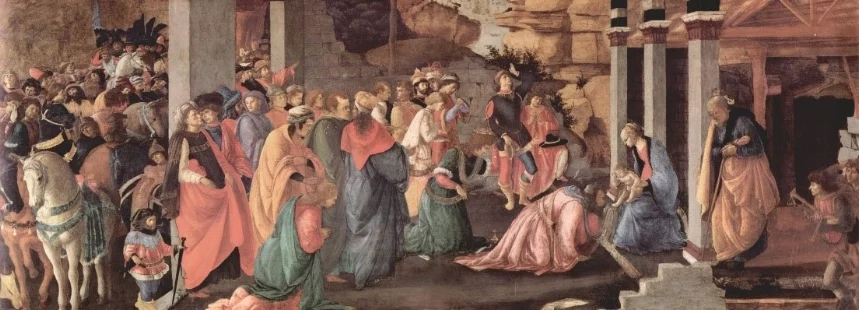
Adoration of the Kings, (about 1470) by Botticelli and Lippi, in the National Gallery, London, England.

Adoration of the Kings, (about 1470) by Botticelli and Lippi, in the National Gallery, London, England.

I like to remind myself—and I am herein reminding you—that Christmas is all that…the birth of fulfillment, promise, and hope. The promise of Christmas began with the prophets, long before the Biblical pregnancy, long before the miraculous birth. In Isaiah 7:14, written twenty-seven centuries ago, the prophecy was: “Behold, a virgin shall conceive, and bear a son, and shall call his name Immanuel.” John in his Gospel tells us that “God so loved the world that he gave His only begotten Son.” As Matthew tells in his Gospel, the birth fulfills prophecy after prophecy and the Star of Bethlehem leads three eastern nobles, the Magi, to the place where they recognize the fulfillment, where they recognize God among us…an Epiphany. Luke in his Gospel tells how the birth is announced by angels to shepherds, who “…spread the word concerning what had been told them about this child, and all who heard it were amazed.” Even the new mother herself, subjected to giving birth in a stable and laying her child in a manger, Luke describes as, “Mary treasured up all these things and pondered them in her heart.” 

In that birth is a promise of unequaled size: God loves us. Symbolically, in December when the nights in the northern hemisphere are their longest (in the Philadelphia area, night will last about 14 hours 40 minutes)…the lights of Christmas banish the darkness. If we’re cold or frightened or lonely or lost or feeling helpless, Christmas is a time of fulfillment and promise and hope…feel and share that wonder. Dare to go bigger than “Pop” culture would have you go…drive around the neighborhoods and see the lights; go into the stores and see the excited expectation; listen anywhere and everywhere to the songs of joy and wonder; raise a glass with family or friend and sense the hope: “God so loved the world…”

Even if you aren’t expecting or if someone close to you isn’t expecting at this time of year, I hope a Christmas hope for you: that you can find all around you and in your own heart the fulfillment, promise, and hope of a miraculous birth.

Spirits

Christmas season is overwhelmingly full of options…here I will limit the options to a few favorite “add-ons,” to use the 21st Century vernacular. Add-ons that highlight both the spirit and the spirituality of the season as well the beauty of storytelling in capturing our imaginations. Both present a spirit of the season—generosity, camaraderie, joy—that is subtle and sentimental and beautifully told.

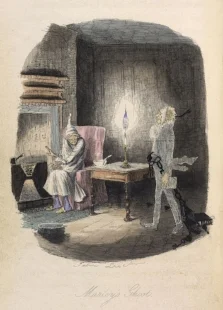
My first favorite is easy: A Christmas Carol by Charles Dickens. I want to challenge people to read the actual story, not just to see it in its many movie, made-for-TV, and stage versions. Dickens’s story itself is very, very rich in language and image and technique. If you dare to read it, you’ll have to ease your mind into a mid-18th Century vernacular…the words are different, the phrases are different, the world was different. No mention of Santa Claus for Dickens’s time, no mention of Black Friday sales or shops open until midnight. A Christmas Carol in its original form is a simple story for a simpler time. The focus is clearly the reclamation of a lost soul, Ebenezer Scrooge, through the inspiration of Christmas. Scrooge may be an icon in today’s world, but he is the singular creation of Dickens in 1843. In his tale, Dickens captures all the frustrated dreams of the poor, all the miserly self-righteousness of the rich, and all the redemptive power of seeing things in a new light. He offers a perfect villain: Scrooge; a pitiful dupe, Bob Cratchit; a hero, Scrooge’s noble nephew, Fred; a feisty heroine, Mrs. Cratchit; a host of scary ghosts, and the purely redemptive Tiny Tim. And, of course, a litany of memorable quotes, such as, ``Are there no prisons? Are there no workhouses?'' or “Bah, humbug!”

If you already know, read, and enjoy A Christmas Carol, then I will also recommend The Man Who Invented Christmas, the story about both the holiday and Dickens’s own redemption through the book. When he wrote his Christmas ghost story, Dickens’s career was in the midst of a downturn…but the book renewed his fame and focused new attention on an ancient holiday.

©2006, Beth Peck

©2006, Beth Peck

Another favorite is a Christmas story that again makes no mention of Santa or any of the commercialism of the season that we know and exercise. A Christmas Memory by Truman Capote is an English teacher’s dream…it is a short story written with the language of poetry. Capote uses repetition beautifully, assonance, alliteration, imagery, epiphany, foreshadowing, metaphor, and on and on. The language is beautiful, the tale is beautiful, the spirit of the story is beautiful. Capote creates a mystical image of his childhood where he as a boy enjoys the mysteries of life at Christmastime with an elderly cousin. He describes their ritual of making fruitcakes as if it were a central mystery of life: 

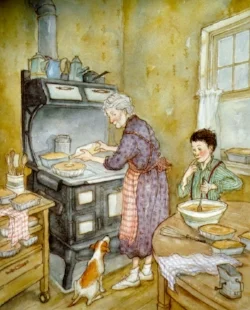
“The black stove, stoked with coal and firewood, glows like a lighted pumpkin. Eggbeaters whirl, spoons spin round in bowls of butter and sugar, vanilla sweetens the air, ginger spices it; melting, nose-tingling odors saturate the kitchen, suffuse the house, drift out to the world on puffs of chimney smoke.”

And the pay-off is an epiphany about the meaning of life so perfectly constructed and revealed near the end of the story that I won’t spoil it by trying to describe it. Other than to say that Capote uses blatant symbolism to end his story...this English teacher’s dream of a symbolic image in simile becoming a metaphor. Fantastic. Treat yourself and read it.

I certainly still enjoy all the holiday standards, Charlie Brown’s Christmas, How the Grinch Stole Christmas, Elf, It’s a Wonderful Life, …I especially love to watch Mr. Magoo’s Christmas Carol from back in the 1960s. But for me the two stories above offer senses of holiday spirit not available elsewhere. 

I’ll end as Dickens did… “as Tiny Tim observed, God Bless Us, Every One!”

Mission

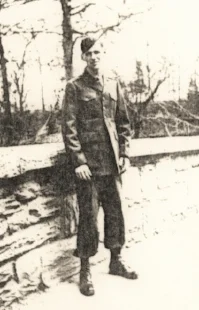
My father at 17 at Parris Island, SC.

My father at 17 at Parris Island, SC.

As a date that has been cursed to live in infamy, December 7th was an actual date when real people across America must have felt exactly what we feel today when our newsfeeds and social media and TV networks cover terrorist attacks. But in 1941, the world-at-large was more mysterious to people…it felt larger and more unknown than it does today. For us, any “breaking news” is met with immediate onsite cameras and realtime reports. In 1941, reports of the Pearl Harbor attack were limited to scratchy reports on the radio or fuzzy newswire pictures a day later.

Below is my father’s remembrance of that day and its impact on his, his family’s, and his friends’ lives. He wrote this remembrance years later, but years ago, too.

[Please note that his use of the politically incorrect and offensive “Japs” is only a reflection of the mindset of 1941: the Japanese had immediately become the hated enemy and American society was consumed with that hatred. I must disclose that by the 1960s, we lived next-door to a Japanese family and my father related to them with common, neighborly decency.]

I was about a month short of my 16th birthday when the Japanese bombed Pearl Harbor. I lived with my parents, sister, and brother in Southwest Philadelphia. My brother, Bill, and I had been to a big high school football game that Sunday, December 7, 1941. Upon returning home we were told the news. We gave a kind of, “What’s a Pearl Harbor?” reaction. Neither we nor any of our friends had ever heard of it. But of course, we knew it meant war. This was of great interest: Germany and Italy took a backseat, now…all was Japan. The sneak attack made them easy to hate and sad to say, even the comics portrayed stereotyped buck-toothed, bow-legged, little men…the enemy.

The following day was declared a holiday from school…not because of war, but because of our football victory for the state championship! As a result, I was at home and heard on the radio President Roosevelt’s declaration of war. It was his “date which will live in infamy” speech.
 

Frank Conlin in his "shiny black jump boots."

Frank Conlin in his "shiny black jump boots."

The war became the prime influence in young men’s lives. I was no different than the rest. I lost interest in school, dropped out about May and started talking about joining the Marines. Frank Conlin, a neighborhood friend, was the reason for my interest in the Marine Corps. He—like many others—had enlisted soon after Pearl Harbor. He became a paratrooper and when I first saw him in uniform with his shiny black jump boots and silver wings, wow! 

I took a job with Sun Shipbuilding Company in Chester in July as a shipfitter’s helper and worked on tankers that had been hit by the enemy and needed repairs.

Frank was stationed in North Carolina and was home quite a bit. We would go out together and I thoroughly enjoyed his stories and plagued him with questions. Once I asked him, “Do you really holler, ‘Geronimo!’ when you jump?” He thought for minute and said, “The Army hollers ‘Geronimo!’ Marines holler, ‘Here we come you Jap bastards!’…or something like that.” This enhanced my admiration for him and the Corps and I was itching to go. I had definitely decided on the Marine Corps. 

Frank was the main reason I ended up in the Corps but there were other reasons, too: the movies I saw and the books I read. No sooner had I read about the Marines in Guadalcanal Diary by Richard Tregaskis, than Frank came home with a direct connection to Guadalcanal: an officer who had served there asked Frank to deliver something to his girlfriend on the Main Line. Frank asked me to go along. The house was magnificent and the landscaping beautiful; a maid met us at the door; down a sweeping staircase came this beautiful girl. She stopped halfway and greeted us. I was intrigued…it was like a movie…her name was Mimi and it fit! She was the essence of the Philadelphia Main Line. I was so young and unsophisticated that I associated that visit with the Marine Corps…I thought all Marines’ girlfriends were like Mimi on the Main Line. What a wonderful organization and I had to become part of it…I was seventeen. I began to bug my Dad to let me enlist early.

A small command of Marines on Wake Island, a tiny Pacific island, had been attacked by an overwhelming force of Japanese. Before the island fell, the story went, the Marines received a radio message asking what they needed. “Send us more Japs!” was their supposed reply. If that didn’t rouse a young man’s patriotic fever, nothing could. I pleaded with my father to sign for me to enlist at 17. My mother had died of tuberculosis the preceding year; had she still been alive, I probably would not have gotten permission. But in the climate that prevailed then and the fact that my father felt that he had “missed” serving in World War I, my pleas were working. But my father warned me, “If you don’t like the Marines, you can’t just come home, you know!?” He was dead serious. I told him, “I may be naïve, but I’m not that naïve.”

On November 30, 1943, I went to the Custom House to join the Marines. I was thrilled as I filled out the forms and was given the physical. I remember how nicely I was treated…and why not? I was probably just what they were looking for: 17 years old, six feet two inches, 180 pounds, and rarin’ to go! After being sworn in, I was “assigned to active duty on a non-pay status.” The officer in charge gave me what he said would be my first “order” in the Marine Corps. I almost snapped to attention. He reached into his pocket, handed me a dime, and said, “Go across the street and get me a Coke.”
 

My father on leave October 1944.

My father on leave October 1944.

I ran all the way. When my mission was complete, I was given the “necessary street car transportation”—an 8-cent trolley token—and sent home to await further orders. On December 16, I was put on pay status and instructed to report to Parris Island, South Carolina. I left by train from the B&O station where my father and sister saw me off. My father’s parting advice, “Be a good boy and remember the sacraments.” I can only imagine how he felt.

I arrived at Parris Island—what the media called “A United States concentration camp”—at 3:00 on a damp December morning in 1943. Finally, I was going to war.

For the record, Corporal Francis P. Conlin Jr. was killed on Iwo Jima, March 10, 1945 at the age of 23. My father served on the battleship USS Texas and participated in the D-Day invasion of Normandy, the Cherbourg bombardment, the invasion of North Africa, and the island battles of Iwo Jima and Okinawa. He was home for Christmas 1945.

Lives

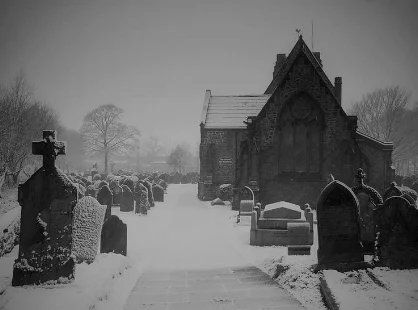
What is it about a gravesite…the silence of the stone itself, or the seeming permanence of the words etched into the stone, or the quiet peacefulness of the place, or simply the tribute it offers to a long-ago soul? Even a new grave gives me a sense of the person’s life and history, not just a death. I don’t intend here to be maudlin, because somehow a person’s burial place exudes a very real, personal quality…a life story. The place and the landscape and the marker amidst all the other stones always suggest to me something very real about the person, very much a sense of a life lived and a resolution, a sense of completion.

I have made a habit of visiting gravesites, especially of literary/artistic figures, and the visits always turn my mind to thoughts of the life that preceded.

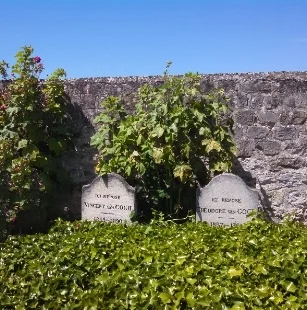
A few years ago during a business trip, I made a side trip to Auvers-sur-Oise on the outskirts of Paris to visit Vincent van Gogh’s grave. The effect of the journey itself flavored my impressions: the confusion in Gare Saint-Lazare and two train rides through the French countryside; discovery of the hotel where van Gogh had lived and worked feverishly in his final days—he completed about 80 paintings in 70 days; my cooling myself in the church that van Gogh had painted…where I listened to the piano tuner finishing his work; then heading uphill along a dirt path to find the graveyard huddled in a wheat field dotted with orange poppies. Van Gogh’s grave lies at the north end of the yard and is distinguished only by its covering of ivy; the stone is beautifully simple with just his name and years and an epitaph, “ici repose” (here lies). He lies next to his very dedicated brother, Theo. It portrays a colorful, quiet, simple life supported by a dedicated brother.

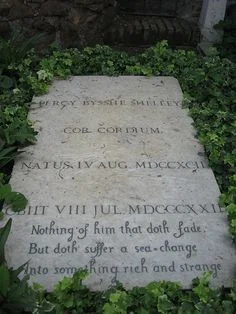
In Rome, I visited the Cimitero Inglesi where both John Keats and Percy Shelley are buried. The neighborhood of the cemetery is less than scenic, it even feels threatening, with graffiti and weeds overrunning the buildings and sidewalks. But the cemetery itself is within a high wall and walking through its gates makes clear the difference: the graveyard is terraced so the graves mount in front of you, rising up a small incline in a manicured garden of flowers and topiaried bushes and gravel walks and pruned trees…and, of course, an overflow of elaborate stones and vaults and statues. Shelley’s grave, at the nearly top tier of the incline is marked with a stone laid flat on the ground, surrounded by small boxwoods and ivy. On it is cut, “Cor Cordium” (Heart of Hearts). He is buried next to Trelawney, a friend who identified Shelley’s drowned body when it washed up on shore…to lie through eternity next to his friend: it portrays a Romantic life with passionate friendships.

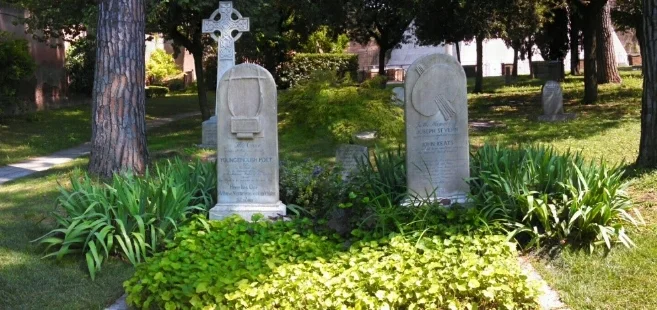
Across the main body of the cemetery in a section with many fewer graves and many fewer plantings and a wide spread of lawn is Keats’s grave. It is marked with an upright stone, which bears his famous epitaph, “Here lies one whose name was writ in water”…but not his name. It stands among ivy and lilies surrounded by a small curb. He, too, is buried next to a friend, Joseph Severn, who had traveled to Rome with Keats to aid him through his illness. It is off in the far corner of the cemetery across from a stone bench nestled in the corner of the cemetery wall, where one can sit and consider the pathetic bitterness carved on the stone…to die at 25 in a far-off land, away from his bride-to-be, at the very beginning of his brilliance would make anyone bitter!

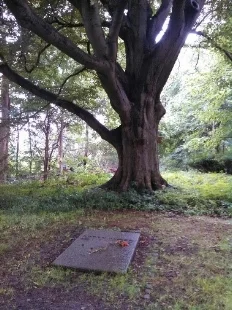
Last year I traveled to Copenhagen and made my pilgrimage to the home/museum of Karen Blixen (penname, Isak Dinesen), about 18 miles north of the city. On a very rainy morning in August, the train dropped me a mile from the museum. Nearly halfway to the museum, I found a path marked as a museum trail…I followed it hoping to find whatever destiny offered. The path wound through a beautifully maintained grove, dripping eerily with rain. I was led to an enormous beech tree and Blixen’s grave, essentially in the middle of nowhere. The flat stone, encircled by a chain, was etched with only her name; someone had thrown a bright red flower onto the stone...it lay wilting in the rain. The scene could not have felt lonelier...nor spoken more eloquently of a lonely life.

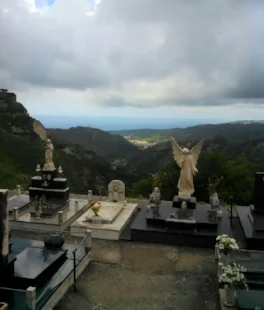
Finally, on a family trip to Italy, we visited the town of Rometta in the mountains of Sicily above Messina…the town from which family emigrated early in the twentieth century. Seeking family records and evidence led us, naturally, to the town’s cemetery. It sits atop a neighboring hill with a magnificent view to the sea and is made up of tombs and statues and markersthe likes of which we don’t find in the United States. The graveyard is crowded with stacked mausoleums and ranks and files of gravestones…all decorated with flowers and photos and statues and elaborate engravings naming “beloved wife” or “dedicated father” or “loving mother.” This cemetery portrays a community: hundreds of years and thousands of lives of family devotion.

It’s just the feeling I get…the cemeteries are so often beautiful and the gardening is an obvious expression of care and artistry and each grave marker tells something tragic or beautiful or mysterious about the souls interred there and the lives that led there.

Feast

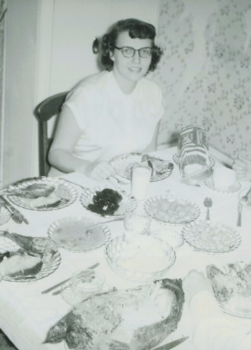
My mother, enjoying her Thanksgiving feast, 1950.&nbsp;

My mother, enjoying her Thanksgiving feast, 1950. 

I remember clearly a Wednesday evening, many years ago, the Wednesday evening before Thanksgiving, when my mother taught me a life-lesson…I think it was as long ago as 1972. She and I were in the kitchen de-crusting and dicing loaves of bread so they could dry overnight to be mixed up as stuffing in the morning. My father came into the kitchen, opened the refrigerator door and stood back to register the full sight: the door and all the shelves were laden with every imaginable ingredient that would become our Thanksgiving dinner…or so I thought. My father said, “Do we really need all this food for just one dinner?”

My mother answered without missing a single dicing motion on the bread, “Thanksgiving isn’t a dinner. Thanksgiving is a feast.” My life-lesson was learned that instant and I’ve observed it ever since. Thanksgiving is a feast and a feast means abundance and excess and abundant enjoyment. A feast is an occasion, not just a meal, where food and drink and people and celebration all meld.

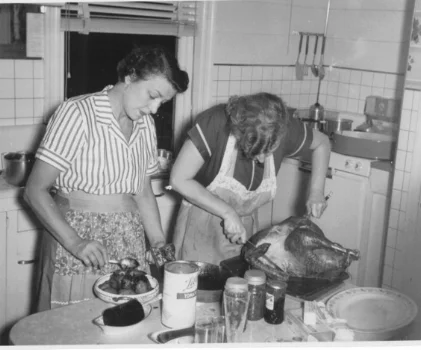
My great-aunt Ada and my grandmother, preparing the feast, 1952.

My great-aunt Ada and my grandmother, preparing the feast, 1952.

Thus my sense of Thanksgiving was burnished. In my earliest years, we’d travel to my grandparents’ house where my mom would join her mom and her aunt in the small rowhome kitchen, where they’d dance around each other for hours of preparation. Later when my mother took over the holiday, I always made an effort to ensure a feast. I’d try to help my mother’s efforts, dicing the bread into cubes or making the cranberry sauce or mashing the potatoes. When I’ve been invited to a Thanksgiving feast, I’ve arrived with cranberry-nut bread or eggnog or bottles of wine, just to expand the feast. Then for years, my mother-in-law created the Italian version of the Thanksgiving feast, beginning the meal with pasta and meatballs and salad and string bean salad before clearing the table to make room for the turkey, stuffing, candied sweet potatoes, mashed potatoes and gravy, cranberry sauce—whole and jellied! In recent years, we’ve hosted the feast, my wife working for days to duplicate the model of a feast that her mother had delivered. Now my responsibilities have expanded to include the hors d’oeuvres: jumbo stuffed olives and tiny pickles and cheeses and crackers and brie with fig jam and radishes and nuts.

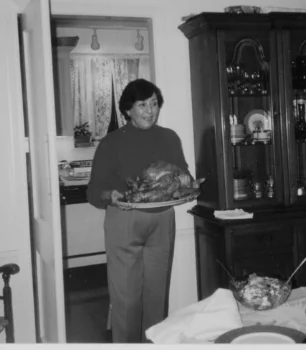
My mother-in-law serving the feast, circa 2000.

My mother-in-law serving the feast, circa 2000.

No Thanksgiving feast would be complete without too many dessert options: the table cleared once again to make room for a display of pies and breads and whipped cream to decorate them and clementines and figs and raisins. Pumpkin pie (always), apple or apple-cranberry pie, sometimes a mincemeat pie, applesauce bread, ginger bread, dessert wines and cordials, and coffee. Ironically, sinful eating to give thanks to God for everything that we have.

In James Joyce’s story, “The Dead,” he describes an elaborate holiday party full of lively conversation and song and dancing and just as much food and drink as I’ve listed above. He spends 250 words describing the dinner table, food, wine and beer…it is a wonderful temptation to recount the bounty of such feasts. His biographer claims that Joyce went to such lengths to describe the party feast because he had been living in relative poverty and could enjoy such abundance only in the retelling of it. I believe that that is a second life-lesson: one of the added beauties of a Thanksgiving feast is that it can feed our imaginations and hearts long after the table has been cleared. In the words of a friend, “Buon appetito!”

Thing

I must have angered the gods when I blogged in August that I am one of the luckiest people I know. They must have decided to punish my hubris…since that time, things have turned downhill in several ways. The sense that I claimed as central to my luck—“disparate elements come together at any given moment in my mind, one that makes the other even better, two that give each other a new quality,”—has now turned into my ability to add insult to sadness to injury!

What can one do when a string of misfortunes just keeps stringing along? When people on whom you’ve depended suddenly begin to let you down? When organizations you’ve trusted demonstrate their untrustworthiness? When places you’ve enjoyed change beyond recognition into strange places, places of unease and discomfort? When neighbors become un-neighborly? When health begins to fail for family and friends and self…even when death descends on loved ones?

I’ve realized that at the core of such suffering is a fear that I’ve long been wrong about so many things. Being betrayed or disappointed by a stranger may hurt, but betrayal by a trusted friend makes one realize one’s misperceptions…and then wondering how long and how often and to what extent you’ve been wrong…that compounds a hurt with self-doubt. So many little, trusted elements of our day can betray us and undermine our confidences. But these are not the feelings nor ruminations of a lucky man…

Even as my luck has changed, I try to hang onto that one thing that can make other things feel/seem/look better. I believe that there is that one thing that drives each of us to do all that we do; that one thing that drives each of us to be all that we are…that one thing that is all that matters…that is everything! I don’t know exactly what that one thing is…and I trust that it is different for everyone…but I believe that there is that one thing that has buoyed me up in the past and will get me through this string of misfortunes.

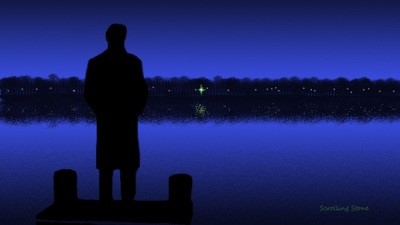
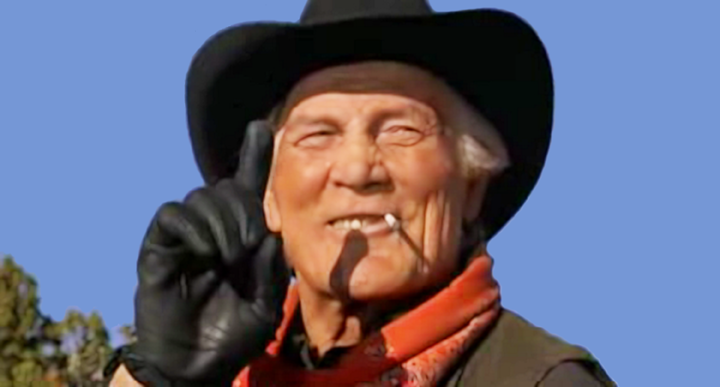
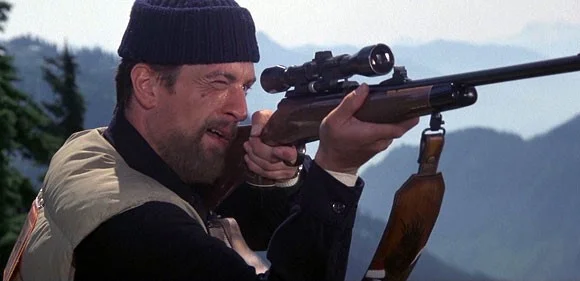
Curley (Jack Palance) in City Slickers (1991) and Michael (Robert DeNiro) in The Deer Hunter (1978) both mention the “one thing” and the “one shot” that we find/get in life; perhaps Gatsby is reaching for that one thing in the form of the green light at the end of the pier when Nick watches him from the bushes, or maybe Dulcinea is that one thing for Don Quixote. I think of it as the tonic of any song, the one basic clear defined tone that gives meaning to all the other notes in that key. Like at the end of the stereotypical knock on the door…rat tat a tat tat, tat…you hear that final note even when it isn’t tapped out. Your head and ears hear it unheard because you know the sound of it even though it hasn’t been tapped out…it’s that one thing that we hang onto and know and trust, even when a string of misfortunes just keeps stringing along.

I suppose it may be what some people call God or Love or Faith…all kinds of nebulous and frightening words. But I think it is a mystery of intertwined values for each of us, making any singular word inaccurate, approximate, unsatisfying. I know that my luck—good or bad, god-sent or god-cursed—won’t overcome my one thing. There is no word for that.

Evil

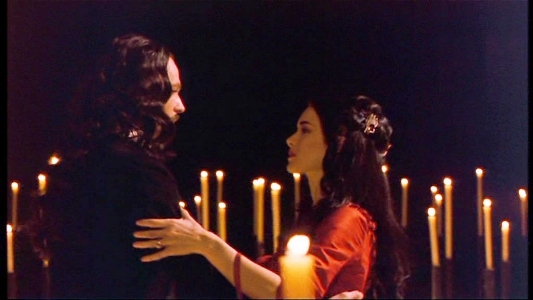
I have many complaints about the movie, Bram Stoker’s Dracula (1992), but chief among them is Coppola’s decision to create an impossible central theme: “Love never dies.” Coppola creates a story about the Count’s unending love for a woman across the centuries and his pledged resentment against God. Coppola’s story makes for a dramatic opening sequence: the dome of the Hagia Sophia shrouded in smoke, followed by a confusion of violence and suffering and blood. But he drives the story from that point forward on Dracula’s love…a choice that is impossible based on Bram Stoker’s original character.

In his original book, Dracula, Stoker creates the title character as the absolute embodiment of evil…incapable of humanity, incapable of good, incapable of love. Even the vampire women say to the Count, “You yourself never loved; you never love!” Stoker creates the Count as a demonic animal, driven only by selfish appetite…for blood, yes, but also for power, worshipers, and evil. When nearly trapped, the Count threatens his enemies, “Your girls that you all love are mine already; and through them you and others shall yet be minemy creatures, to do my bidding and to be my jackals when I want to feed.” In Stoker’s creation, the vampire is only selfish appetite…anathema to any idea and ideal of Love. Stoker expands the threat of Dracula’s absolute evil, when his main adversary, Dr. Abraham Van Helsing, says that Dracula “must go on age after age…multiplying the evils of the world.  And so the circle goes on ever widening, like as the ripples from a stone thrown in the water.”

Stoker’s central theme is a complex weaving of the simplistic idea of “Good versus Evil.” But Stoker takes the idea to its limit: he creates the Count as absolute Evil—yes, with a capital E—and challenges a band of five men and a woman to rise as high as they can to defeat him with Good—yes, with a capital G.

A difficulty with the book Dracula is the absolute natures of both the Good and the Evil that Stoker portrays. Ironically, when I taught the book to high-school Seniors, these modern readers accepted the Count’s absolute Evil so much more easily than the absolute Good of his adversaries. The students found the band who battle the Count silly…how they are tied together through deep love and friendship, deep trust and generosity, and an explicit knowledge and commitment to those principles. The band spends more time describing and pledging their noble feelings than they spend actually fighting Dracula. At one point, the head of the band, Van Helsing, says quite simply, “There are darknesses in life, and there are lights.” But the students—and I think all modern readers—have difficulty believing in such clearly stated and acted Good. Today, that level of Good seems reserved for the comic-book style heroes, like Superman and Supergirl, not for realistic characters.

Thus, when Coppola gives the Count his motivation—Love enduring through the centuries—I must object. These are neither the characters nor the story that Bram Stoker created. If Coppola’s Dracula (Gary Oldman) loves Mina (Winona Ryder), he is not the irredeemable demon that Stoker created; if Mina could be clear-headedly attracted to the Count, she is not the angel at the center of the band that Stoker created; and then the whole central theme of “Good versus Evil” falls out. Coppola gives us a story about a somewhat justified vampire being murdered by those who don’t understand his angst…this is my chief complaint. I don’t care to list my other complaints.

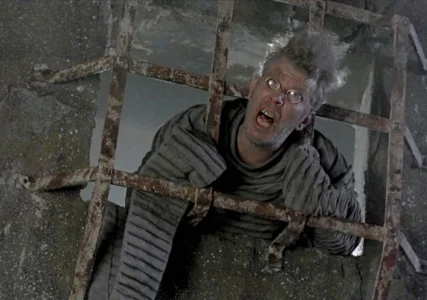
On the other hand, I enjoy a few things about Coppola’s movie: the art direction is lush and exciting—if a bit too Tim Burton-esque; many of the Gothic affectations are very powerfully fun: the independent shadows in the castle, and the night of terror when the vampire women seduce Jonathan (Keanu Reeves); Tom Waits’s mad portrayal of the madman Renfield; and the over-the-edge eroticism of an otherwise repressed-Victorian story…the vampire women’s and Lucy’s unabashed yet discreet seductiveness.

Coppola surely knew how to create a modern, visually exciting story, with its CGI and its misunderstood antihero; and Stoker surely created a Victorian Gothic, conceptually moral story for the ages, with heroes and a heroine and an absolutely Evil villain. But they are not the same stories.

Creepy

During the Halloween season, horror stories of every kind thrive: on film, in books, in commercial haunted houses, and even in neighborhood front yards. Horror stories include everything from ghost tales for children, designed to make the dark feel scarier, to the extreme “torture porn” movies of maniacs, torture, terror, and rivers of blood.

Personally, I prefer the fright of things “creepy”…that strange scariness that makes me nervously afraid and apprehensive. I prefer the subtle fear of ghost stories—more than the grotesque fear of slasher stories—where the danger is uncertain, the adversary is a mystery, and the possibilities create a sense of fears unknown.

My favorite example of subtle fear is Henry James’s Turn of the Screw. First published in 1898 as a serialized story in Collier’s Weekly, the story carefully presents a gradual realization by the unnamed narrator/nanny and then her stepwise campaign to save two possessed children…the story progresses methodically and cautiously, like the turning of a screw in the title. When the narrator first senses and then sees one of the ghosts, James builds the scene with growing realization and prolonged interpretation by the narrator: “I became aware that…we had an interested spectator. The way this knowledge gathered in me was the strangest thing in the world.” No slashing screaming ghosts in this story! The narration is calculated; the motivations of the heroine are deep-rooted; the innocence of the children is too perfect; and the ghosts are ravenous to possess them; yet James gives us fears through a narrator and children and ghosts who are ambiguous. The ghosts and their haunting seem real and frightening, but doubt makes it all creepy…a nervous apprehension for the children…is it the ghosts or the narrator who threatens them?

Then in 1961, Jack Clayton adapted James’s story to film—an adaptation I love because it honors the original subtle creepiness and accentuates it appropriately. The Innocents is a psychological ghost story that maintains the lushness of James’s prose and exploits all the uncertainty, mystery, and ambiguity of his story. The opening 45 seconds—a child’s voice singing a morbid song before any visuals begin—introduce an immediate creepy sense, which is then reinforced with a shift to birdsong and weeping as two wringing, praying hands appear. A trapped, claustrophobic feeling begins here and pervades the film. Deborah Kerr, as the governess Miss Giddens, gives a powerful portrayal of James’s frightened and frightening narrator.

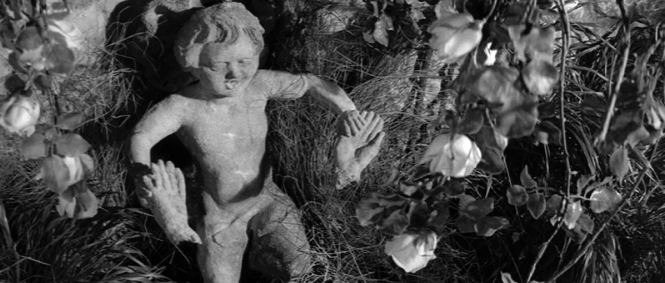
Clayton chose to work in black and white to deepen the shadows of the story and created over-lush sets to mimic James’s rich language; cinematographer Freddie Francis focused the visuals with special filters to darken and blur the edges of nearly every scene; and Truman Capote adds his Southern gothic perspective of both language and elements. For example, Capote invokes creepiness without forcing straightforward horror when the girl, Flora, innocently observes, “Oh look, a lovely spider and it’s eating a butterfly.” He populates the story with statuary, birds, reptiles, and bugs…inhuman characters as creepy as the ghosts.

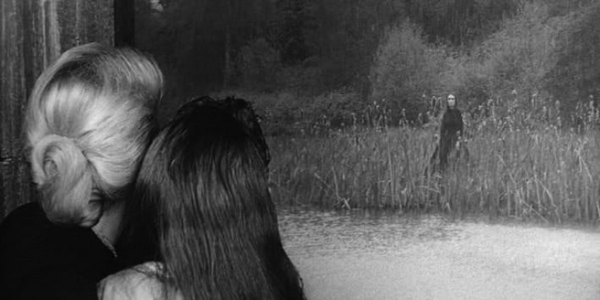
Clayton introduces the ghosts themselves always through the eyes of the governess…we see her reaction first and then we see—or think we see—the ghosts. They appear through fogged glass or a haze of fog on the tower or, when in plain daylight on the lakeside, the ghostly image is blended grey into the surrounding landscape. Are we seeing them or is she imagining them?

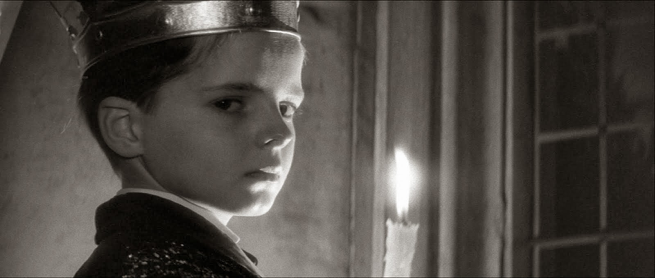
Both children are played perfectly, in their own ways scarier than Regan in The Exorcist. For the final creepiness, the boy, Miles, exudes a growing sense of perverse maturity as he evolves into adulthood in the presence of the governess. Although just a boy, he plays into a suggestive role through his language and comportment. While at dinner—when Miles says that he “feels quite the master of the house”—he offers to protect Miss Giddens and reaches his hand across the table; she is disarmed and reaches to take his hand but he giggles and slaps an aspic rabbit instead…which wobbles grotesquely and erotically. The tension and interplay between these two characters is suggestive, ambiguous, tortured, and creepy—they share two kisses, each more creepy than the other!

If the Saw franchise of torture porn is your idea of good horror, then neither Turn of the Screw nor The Innocents is for you. But if you want the subtle creepiness of psychological uncertainty and you enjoy the masterful telling of a gothic ghost story…treat yourself to either or both.

Octoberly Magic

In Pennsylvania, Octoberly magic is in full bloom…it has been evolving slowly as the Sun sets earlier and rises later and piles of pumpkins accumulate and show themselves everywhere and in the cornfields the corn stalks rattle dry in the breeze and the temperatures never rise to 80 anymore during the day. I awake in the partial dark of dawn now, my ride home from work happens on the light side of dusk and will happen on the dark side of dusk in a week or two, and soon the night will outlast the day by far. Orion is already showing up in the late night to dominate the sky. I wonder how people in other places around the world get to enjoy Octoberly magic…I’ve just reclaimed my sweaters from the cedar closet and laid the quilt on my bed. I’ve treated myself to mashed potatoes and roasted acorn squash and butternut squash soup and stewed apples and spiced wafers and, yes, even a bag of orange-crème filled Oreos. October’s portrayal of all the beauty of autumn is here!

Later in autumn, other concepts beyond the falling cold and the slanting Sun begin to dominate the imagination. In November, our thoughts turn to Thanksgiving—an autumn holiday, true, but one with its own sensibility of family and abundance and scholastic football. In December, the Christmas holiday and ideas of winter will dominate, even though autumn persists through two-thirds of the month. So we are left with late September and October to fire our imaginations of autumn.

For me, here in Pennsylvania, autumn and October are contained in a single image: the pumpkin. Certainly autumn has other abundances: apples (Honey Crisp being the ugliest but most delicious) and nuts and squash and mums. But pumpkins seem to present a personification of the season…durable, swollen plump, heavy, seed-filled, and bright orange. I had the joy thirty years ago of seeing a pumpkin field in the distance as I drove through Connecticut…a dry-brown acreage dotted with orange; it is a unique image of autumn that has stuck in my imagination. 

One year, my wife and I made a terrible mistake by going to Linvilla Orchards the day after Halloween; around the grounds, dozens of large wooden crates that in recent days had been piled high with pumpkins-for-sale were left nearly empty…except for the depressing shards of smashed pumpkins that hadn’t survived to decorate someone’s stoop. The sight of the shards and seeds mashed at the bottom of the crates depressed me terribly, as it does even today as I write about it! Seeing unsold Christmas trees the day after Christmas may be depressing, but not so depressing…somehow the pumpkins are more human, more personified—probably because of the possibility of their becoming Jack-o-lanterns—and seeing them lost to misfortune in the bottoms of wooden crates was very sad. 

Testament to the autumnal quality of pumpkins is the ubiquity of “pumpkin spice” as the natural marketing campaigns of the season. It seems that everything that can be flavored with pumpkin spice is flavored with pumpkin spice: coffee, candy, bread, ice cream, muffins, pancakes, waffles, milkshakes, candles. I wait each year to see the next addition to the pumpkin-spice litany…laundry detergent? Scented tissues?

Treat yourself: buy a pumpkin and sit it somewhere prominent at your home. Near the front door or in the middle of the kitchen table. Everyone who sees it will sense the season and enjoy the Octoberly magic of it.


Constancy

During my summer visit to New York’s Metropolitan Museum of Art, I thought at first that I had stepped into an amusing coincidence. As I’ve thought about it since, I’ve come to realize instead that a truth had been offered to me that day.

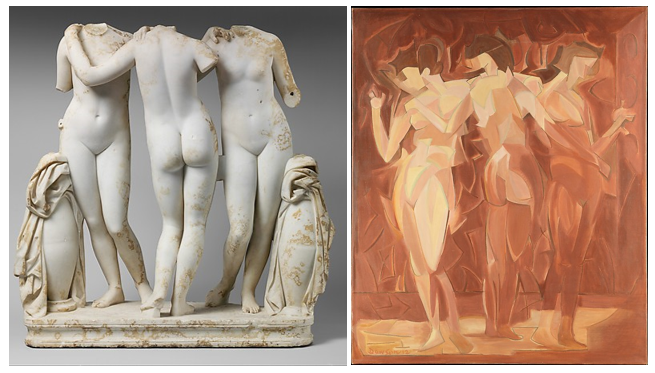
My son and I entered the main lobby, turned left, and wandered into the Greek and Roman Art gallery…statues, pieces of statues, tombs, and columns of marble. We happened upon the remains of a second century Roman statue, Three Graces. The perfection of the marble statue has been damaged by time—the heads and arms of the figures are missing. But, of course, the perfected human forms are still striking: an incredibly human appearance of three women, known to the Greeks and Romans as the Three Graces: Beauty, Joy, and Abundance. We both paused a moment to admire the statue and imagine the impact of when it had been whole. It seemed a very ethereal, mythical, ancient piece of art. Three beautiful ladies making a kind of dancing circle, symbolizing all that is festive and pleasurable in the world.

We made our way to the back of the museum into the Modern and Contemporary Art gallery: Balthus, Matisse, Modigliani, Picasso, and so many others. The works are, of course, very modern…impressionist, abstract, pop. We were looking at a particularly abstract, enigmatic Picasso when I said, “It’s amazing that artists who used to create things like that statue evolved to create this thing.” For an instant we were both amused, until we noted that the next painting on the wall, by an American artist (Manierre Dawson) in 1912, was the very same ancient subject:  Meeting (The Three Graces). “Oh my God,” my son said. “Here’s the Three Graces again!” 

It seemed an idle coincidence…we had happened upon two versions of the same concept expressed 1700 years apart: The Three Graces. Mythologically, they were conceived as goddesses who brought an abundance of the pleasures of life. Over the centuries, expressions of a central human need for these pleasures—grace and beauty and creativity and joy and abundance—and their personification have persisted. We learned that day that in ancient Rome and centuries later in Chicago the simple, central, human love of these graces gave rise to an artistic expression. 

Since then, I’ve come to realize that our “happening upon them” in the museum that day wasn’t just a coincidence…because I have since found that the portrayal of the Three Graces has gone on all over Western society all the time: in Florence, Italy in 1480; in Antwerp, Belgium in 1640; in Paris, France at the end of the 1700s; in Woburn, England at the beginning of the 1800s; in Dawson’s Cubist work in 1912 and James Joyce’s story, “The Dead,” in 1914; in Indianapolis, IN in 1925; and even more modernly in Milwaukee, WI in 1965. 

I’ve come to understand that notwithstanding the evolution of art, some things are constant. We may see the specifics of beauty and joy and abundance differently; we may sense them differently; we may express them differently; we may experience them differently; but at the center of human experience seems to be a constancy of longing, a longing for these goddesses who bring an abundance of the pleasures of life.

Memory

I am, at heart, a dedicated Henry James fan and I will likely write future blogs celebrating his work. But here I want to contradict something he said in his travelogue, Italian Hours. After having enjoyed the beauties of Venice, James writes, “Exquisite hours, enveloped in light and silence, to have known them once is to have always a terrible standard of enjoyment.” I understand his point about the power of a perfect experience…it stays with us. But to me, the “terrible standard” is the wrong approach to a wonderful memory.

I’ve had exquisite hours to which I love to return, to sense again, to enjoy again. Memories, for me, are a comfort and delight of the past just as dreams are a comfort and delight of the future. Even during the dullest hours of today, I love to return to many of those experiences that were, for me, exquisite:

  • To my evening a decade ago in Prague when, lost in the dark on winding winter streets, I encountered two young ladies at an intersection that none of us knew. “Do you speak English?” they asked me, shivering against the cold. “Yes,” I said, “I’m from Pennsylvania.” They were as lost in search of their hotel as I was in search of my restaurant. They, too, were from Pennsylvania and we laughed at the coincidence. It was February with snowflakes on the air and the temperature at a negative Celsius…about 8 degrees Fahrenheit. I had passed their hotel a few blocks back and I directed them as well as I could; they had passed my restaurant and hesitantly directed me…we parted and I was soon warm at table with menu in hand. I enjoyed wine with my dinner and wondered if they’d found their hotel.
  • To my dinner in Vienna when a funny little sommelier—a bespectacled man who resembled Wally Cox in size and appearance—introduced me to grappa. I had had an excellent meal in the excellent company of friends and asked the server which of the two grappas on the menu was better; “Let me get the sommelier,” she said. I think the sommelier had waited his whole life for that question…he explained the prestige of a vineyard’s grappa and the process for distilling it and the tradition of the crystal bottles and the differences among vineyards that flavored each grappa. “I’ve just returned from Italy with two grappas that are not even on the menu yet,” he said. I asked him to serve me the best of the lot and he returned with two glasses, serving each of the two new grappas. Each had its own flavor, both burned the taste of dinner from my mouth and throat…I’ve enjoyed grappa ever since.
  • To my visit with friends to a wine bar buried in a hotel on the twisting streets of Tangier. We had traveled all day—a 6-hour train ride from Madrid, a 3-hour ferry ride across the Mediterranean, and an hour taxi ride into the city—to find ourselves, finally, gathered at the bar. We had concocted our adventure: a visit to Morocco that would last just hours. The bartender spoke English beautifully to offer us French or Spanish wines, “…but why not try our Moroccan wine, they are just as good and only 200 dirham,” he said. We took his advice although we didn’t share his opinion…the wine was not as good as the French or the Spanish wines, but it was cheap and we were tired and it was fun to be drinking Moroccan wine in the north of Africa.
  • To my habit in earlier years of taking evening walks on the beach in Wildwood, NJ, where the beaches had grown so wide that walking on the water’s edge felt miles away from the noise and bluster of the boardwalk. I was among very few people at that hour on the beach, all of whom were relaxed and purposeless. The blazing afternoon Sun had sunk to the west and the darkness rose in the east, making the beach feel impeccably private. I often spent my evening off—just one day a week—flying my red kite and enjoying an imagined notoriety as people on the boardwalk would wonder whose kite it was in the sky and I imagined how they’d trace the string back to its origin, to find not a child, but a grown man—a tall grown man—dancing his kite in the sky.

Henry James was both wrong and unfortunate: to have known exquisite hours is a wonderful well from which I draw again and again.

Autumn

River Itchen in autumn, in Hampshire in the south of England.

River Itchen in autumn, in Hampshire in the south of England.

Tomorrow, September 22, is the first day of fall—the season so nice, they named it twice: fall and autumn. The Earth passes the equinox—the Earth’s pole is pointed parallel to the Sun, neither toward it nor away from it for one small instant, making day equal to night. It is the season when some people regret the fading of summer, but others rejoice in the cool beauty and colors of autumn. I am among the latter…how everything luxuriates in the shifting border between waning days of warmth and waxing nights of cool clarity, how the humidity passes, how the air moves with new sharpness, and how everything begins to turn inward against the coming cold. Autumn brings an automatic sentimentality with it, a sense of having survived the heat and a preparation for the future cold; as Fitzgerald’s Jordan Baker says in The Great Gatsby, “Life starts all over again when it gets crisp in the fall.”  

But I am more mindful, always mindful, when fall comes, of Keats’s “To Autumn,” what some—myself included—call the most beautiful poem in the English language. He drew an image of autumn that overflows with activity…he persistently turns verbs into adjectives to create a scene that we can “watch” in an active sense, not just “see” in a painterly sense…in his ode of 254 words, he uses 49 verbs and verb forms…just about 20% words of action and movement. Keats profiles autumn as it turns the rich ripeness of late summer into the dead cold of winter…and he makes it happen with words for all our senses: “to swell the gourd” (visual), “by a cider-press…the last oozings” (taste), “the fume of poppies” (scent), “hedge-crickets sing” (aural), “a wailful choir” (vocal), and “until they think warm days will never cease” (tactile). Then he uses that high-school-English personification to see autumn as a woman sitting on the granary floor with her hair being lifted by the winnowing wind…it is a beautiful praise to the season in action and images and anticipation.

Ironically, Keats wrote the poem after a walk in the countryside on September 19, 1819…a few days before autumn technically began and a little more than a year before he died. At the age of 23, Keats devoured the beauty of what he saw along the River Itchen and was moved to forge those impressions into an ode…that is the curse of the poet: his drive to capture and represent in language everything his senses perceived. If he died too young, at least he relished every moment as it came…in writing.

My initial goal in this blog is to express my relevance…and I am sad that the delicacy and passion and beauty of poetry is so rarely appreciated anymore. I think, therefore, that I am somewhat irrelevant with this posting. But only somewhat…I believe that a thing of beauty will never be completely irrelevant. And so, that is my curse: my drive to capture and share in language the beauty I enjoy. I’ll finish simply how Keats beautifully began, “Season of mists and mellow fruitfulness.”

Living

Gene Wilder(© Dave Pickoff/Associated Press)

Gene Wilder
(© Dave Pickoff/Associated Press)

As is typical when popular figures die, the Internet was suddenly abuzz about Gene Wilder when he died last week…true stories, apocryphal stories, secret stories. His life and career were being evaluated by anyone who felt the impact of his death, whether that person is qualified or unqualified to offer an opinion.

I am among the latter group, the “unqualified,” and so my opinion is actually about something Wilder said in his role as Willy Wonka, words written by Roald Dahl, but brought to life by Wilder. After little Charlie Bucket proves himself worthy of Willy Wonka’s trust, Willy says to him at the movie’s end, “But Charlie, don't forget what happened to the man who suddenly got everything he always wanted. …He lived happily ever after.”

I have always found myself doubting the concept of “happily ever after,” no matter where I find it. “Happily ever after” seems to last only until the next month’s bills come due or until the next doctor’s visit. However, I’ve realized that the important element in Wonka’s pronouncement is the verb phrase, “lived happily.” Wonka (Wilder) doesn’t tell Charlie to “be happy” …he tells him to “live happily.” A major difference that I completely support…making an explicit and conscious effort to live a certain way…active verb and clear adverb.

Of course, if a man had everything he’d always wanted, it might be easy to live happily. That man—or woman—could enjoy his family, friends, home, car, investments. But life isn’t so simple. For any man or woman, having a family and friends and a home and a car and investments puts him at risk: so much to protect, so much to lose!

Being the lucky man that I proclaimed myself to be in an earlier blog, I am a man who has everything I’ve always wanted—not suddenly, but everything. Yet I find myself frequently struggling to take Wonka’s advice: live happily. Life continually sends challenges and disappointments, charlatans and thieves, illness and tragedies…life is not a happy thing all by itself. But I try explicitly and consciously to live happily.

Look at Charlie’s first reaction when initially Wonka tells him that he has lost: deep disappointment and disillusionment are clearly in Charlie’s face. At the same time, though, Charlie redeems the moment by returning the Everlasting Gobstopper to Willy, an explicit and conscious effort to reject Grandpa’s plan for revenge. An explicit and conscious effort not to give in to the disappointment. “So shines a good deed in a weary world...” says Wonka—quoting Shakespeare—and Charlie suddenly gets everything he'd always wanted: the chocolate, the chocolate factory, the Oompa Loompas, a new home for his family….and Wonka challenges him to “live happily.” Perhaps I’ve read too much into the line—the closing line of the movie—but I like it better that Wonka is challenging Charlie than lying to him.

I am a “dreamer of dreams" that Wonka says we are. Living happily is a dream of mine…a dream that is evasive and difficult and tiring…a dream worth dreaming: living happily.